Species distribution
Type of resources
Topics
INSPIRE themes
Keywords
Contact for the resource
Provided by
Years
Formats
Representation types
Update frequencies
status
Scale
-
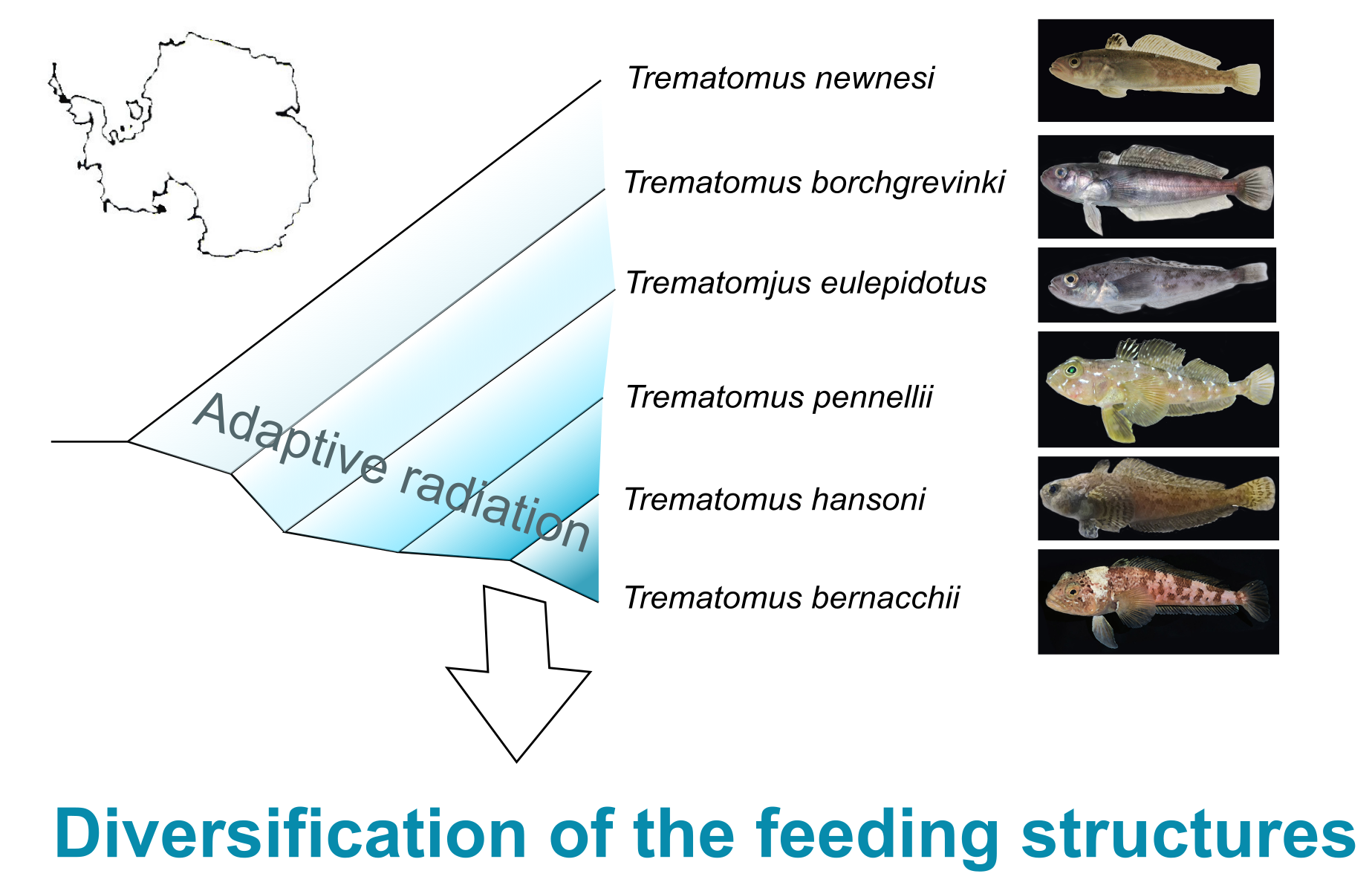
The EMPHASIS project focuses on the ecomorphology of the feeding apparatus of Notothenioidea, a suborder of teleost fishes endemic to the Southern Ocean that have colonized available ecological niches and habitats during their adaptive radiation. Ecomorphology is the science that investigates the reciprocal relationship between the environment and the forms of organisms, allowing insights into their evolutionary history, biodiversity, and relationships between form and function. The research activity involves a comparative analysis of the feeding apparatus in species representative of various phyletic lineages, and the study of the relationships between morphology, function and specific performance during feeding. Based on the results of the analysis, three-dimensional digitally supported models of the structures involved in feeding activity was developed.
-

In the Project PermVegNet (OSS-12) there are 15 sites between 73 and 78°S in which vegetation is monitored every 3 years on a variable number of plots (from 1 to a maximum of 3 for each site) with a 2x2 m size. The vegetation monitoring is performed through the phytosociological method and provides total cover (%), species richness and the dominant species.
-

The fungal communities in rocks and soils of three different localities (Battleship Promontory, Richard Nunatak, Trio Nunatak), where stations are collecting climatic data, have been compared with a DNA metabarcoding approach. The results showed a strong differentiation in the communities diversity and composition between the two substrates, with an higher diversity in soils compared to rocks.
-

The bacterial communities in rocks and soils of three different localities (Battleship Promontory, Richard Nunatak, Trio Nunatak), where stations are collecting climatic data, have been compared with a DNA metabarcoding approach. In addition samples have been trated with Propidium Mono-Azide (PMA) which binds to DNA of damaged cells and inhibit its replication via PCR. The comparison between samples treated with PMA and samples not treated allows to check the bacterial cells that are intact and potentially alive in these substrates. The results showed a strong differentiation in the communities diversity and composition between the two substrates, with an higher diversity in soils compared to rocks. In addition, the PMA treatment revealed the presence of an high proportion of death cells, whose amplification in traditional metabarcoding approaches obscures the correlation trends in this environment.